
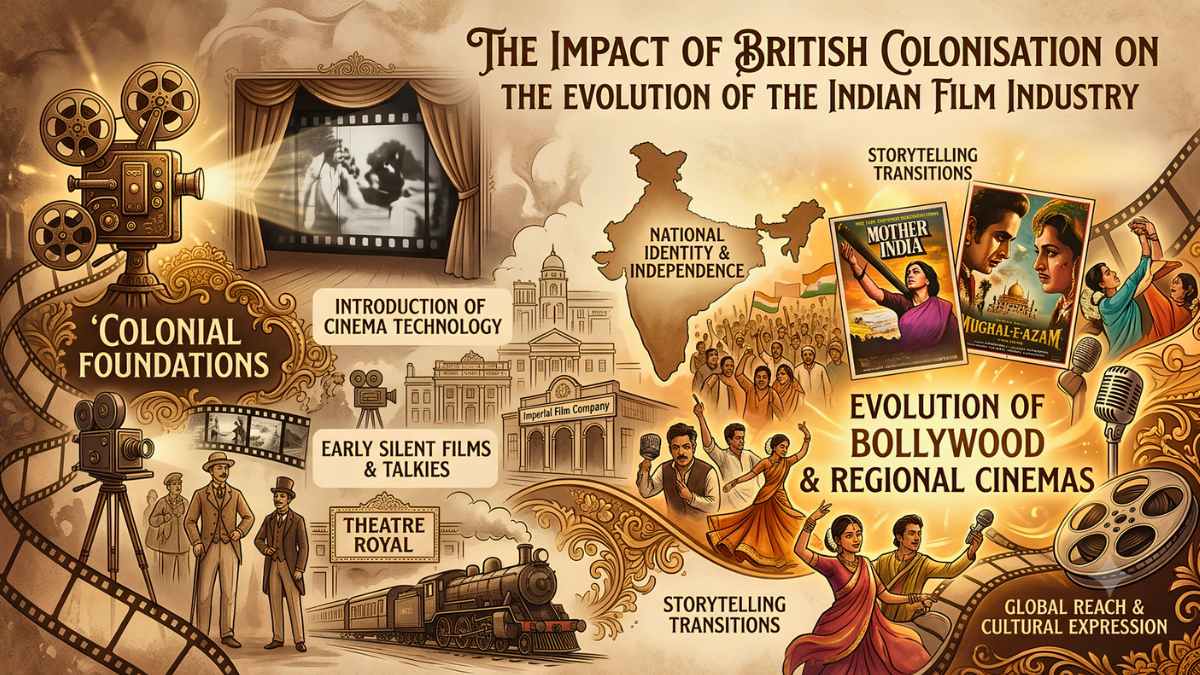

Indian cinema did not emerge in isolation. It grew up under British rule, and that context shaped who could make films, what stories were allowed on screen and how audiences came to see themselves. Colonisation was not incidental to the industry’s early history. It was the environment in which that history took place.
The arrival of cinema under colonial rule
The Lumière brothers’ short films had their first Indian screening on 7 July 1896, at Watson’s Hotel in Bombay. The audience was largely made up of Europeans and the city’s wealthier residents, since the hotel itself excluded most Indians at the time. Cinema entered India through a colonial social structure, and that structure shaped who got to watch, and eventually who got to make, films in the years that followed.
By 1913, when Dadasaheb Phalke released “Raja Harishchandra,” widely regarded as the first full-length Indian feature film, he had spent years raising funds and building the technical know-how largely on his own, partly because British-run distribution and exhibition networks favoured imported films. Phalke’s decision to draw on Hindu mythology for his subject matter is often read as a deliberate act of cultural assertion at a time when Indian stories had little standing in the commercial entertainment on offer.
Language, class and access
English was the language of colonial administration, higher education and much of Indian public life under British rule. That mattered for early cinema because the people with the capital, contacts and formal education to start film production, most of it concentrated in Bombay, Calcutta and Madras, tended to be drawn from an English-educated, urban elite. This did not shut Indians out of filmmaking; quite the opposite, Indians dominated the industry numerically from the outset. But it did mean that access to the industry’s early infrastructure was uneven, favouring those already positioned within colonial commercial and educational networks.
Technology, licensing and control
Film stock, cameras and projection equipment mostly had to be imported, and that trade sat inside a wider colonial economy of tariffs, licensing and shipping controlled from London and Delhi. Studios needed formal registration and were subject to municipal and provincial regulation. None of this was designed with Indian cinema specifically in mind, but it meant that the costs and bureaucratic hurdles of running a studio were real, and they fell more heavily on Indian producers operating with less capital than the larger, foreign-backed distribution firms.
Censorship and the Cinematograph Act of 1918
The clearest instrument of colonial control over Indian film content was the Cinematograph Act of 1918, passed after a bill first proposed the previous year. It required films, Indian and foreign alike, to be licensed by newly created censor boards before public exhibition, ostensibly on grounds of public safety and morality. In practice, the boards, which began operating in Bombay, Calcutta, Madras and Rangoon from 1920, were also used to screen out material seen as sympathetic to the nationalist movement or damaging to the image of British rule. The Act remained the basis of Indian film censorship for decades, amended in 1949 to introduce the “A” and “U” age classifications, before being replaced by the Cinematograph Act of 1952, which still underpins the Central Board of Film Certification today.
Filmmakers working under this system leaned heavily on mythological and historical subjects, genres that were harder for censors to read as overtly political, and used allegory to carry messages that could not be stated directly. This shaped Indian cinema’s early narrative style in ways that outlasted colonial rule itself.
Representation and the colonial gaze
Some scholars of early Indian cinema have argued that colonial-era aesthetic hierarchies, including preferences around skin tone and Western dress, filtered into how heroes and heroines were styled and cast. This is a real strand of academic and critical debate, and it connects to the wider, well-documented history of colourism in South Asian visual culture. It is worth treating as one influence among several rather than a settled, uniform rule, since early Indian silent and studio-era cinema also drew heavily on indigenous theatrical traditions, including Parsi theatre, folk performance and Sanskrit drama, which had their own distinct visual conventions.
Independence and after
Independence in 1947 did not immediately dissolve the institutions or habits of mind that had built up over half a century of colonial rule. The 1918 Act’s censorship apparatus was carried over, and Bombay’s commercial studio system, along with distribution patterns established under British rule, continued largely intact. Change came gradually. Satyajit Ray’s “Pather Panchali,” released in 1955, is often cited as a turning point… a work rooted in observed Bengali life rather than either colonial-era spectacle or the mythological and social conventions of mainstream studio cinema, and one that brought Indian art cinema international recognition through its screening at Cannes.
An uneven legacy
British rule left Indian cinema with real constraints… restricted subject matter, uneven access to capital and equipment and a censorship regime built to serve imperial interests. It also left behind infrastructure, notably the railway network, that helped films and reels move around the country, and exposure to international cinema and technical training that some Indian filmmakers were able to draw on. Neither point cancels the other out. Indian cinema’s rapid growth after independence, and its emergence as one of the largest film industries in the world by volume of output, owes more to the resourcefulness of Indian filmmakers, producers and audiences than to anything the colonial administration intended. But the industry’s early shape, who could make films, what they were allowed to say and how they were seen, was set during the period of British rule, and traces of that history are still visible in the industry today.
Key facts at a glance
- First film screening in India: 7 July 1896, Watson’s Hotel, Bombay.
- First Indian feature film: “Raja Harishchandra,” 1913, directed by Dadasaheb Phalke.
- Foundational censorship law: the Cinematograph Act of 1918, in force from 1920.
- Post-independence turning point: “Pather Panchali,” 1955, directed by Satyajit Ray.
- Current censorship framework: the Cinematograph Act of 1952, administered by the Central Board of Film Certification.