
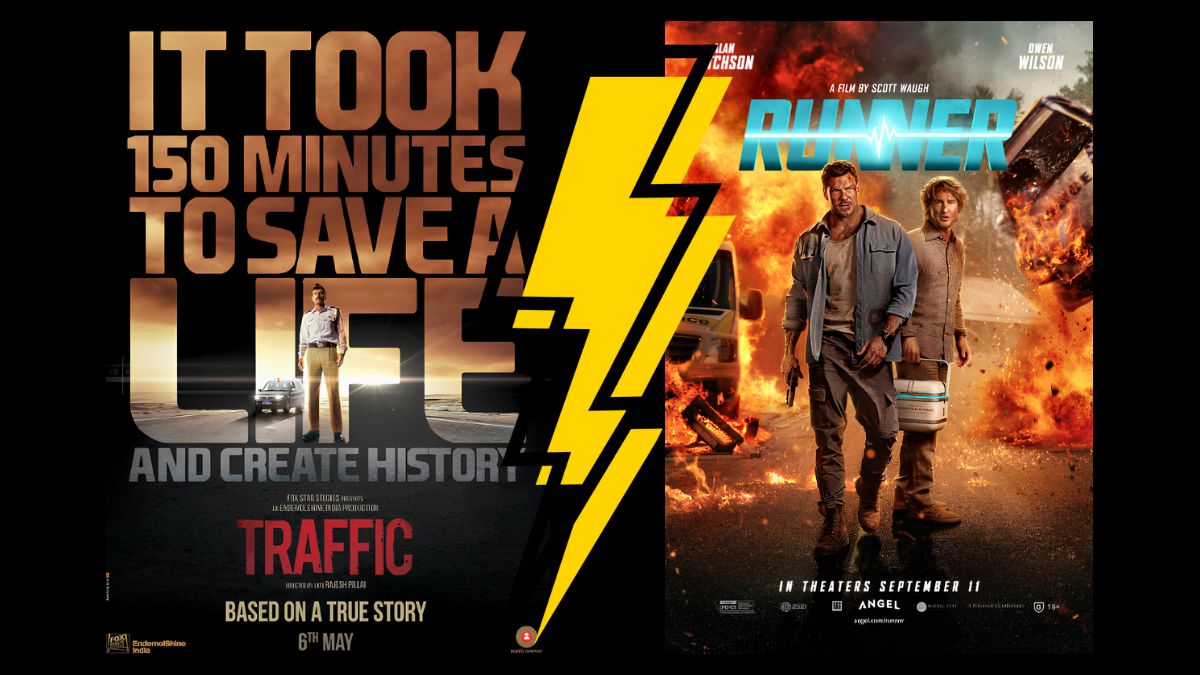
Did Hollywood Copy Bollywood?
Comparing Alan Ritchson’s Runner (2026) and Manoj Bajpayee’s Traffic (2016)

When the trailer and plot details for the 2026 action-comedy Runner, starring Alan Ritchson and Owen Wilson, dropped, Indian cinema fans immediately noticed a familiar premise. A race against time across long distances to deliver a human organ to save a young girl’s life? For anyone who remembers the gripping 2016 Hindi thriller Traffic (and its acclaimed 2011 Malayalam original), the setup felt remarkably close to home.
With social media debates sparking over whether Hollywood borrowed a page from Indian cinema, it’s worth taking a closer look at both films. Does Runner owe its soul to Traffic, or is this simply a case of two very different industries using the same high-stakes ticking clock?
The Core Premise: A Familiar Race Against Time
On paper, the loglines of both films share undeniable DNA. Both stories center on an urgent medical mission where every second counts and a child’s life hangs in the balance:
- In Traffic (2016): A harvested heart must be transported from Mumbai to Pune in under two hours through treacherous monsoon rains and bumper-to-bumper traffic to save a superstar’s daughter.
- In Runner (2026): A former military operative (Alan Ritchson) and a neurotic medical courier (Owen Wilson) must transport a rare donor liver across Australia within a tight deadline to save a seven-year-old girl.
In both movies, the organ is the ultimate ticking clock. If the delivery is delayed, the organ expires and the child dies.
Why Runner Isn’t Actually a Copy of Traffic
Despite the matching medical emergency at the center of both plots, calling Runner a remake or a copy of Traffic misses the massive differences in how the two films were conceived, written and executed.
1. True Story vs. Hollywood Action Fiction
Traffic, originally written by Bobby and Sanjay in Malayalam before being adapted into Hindi by director Rajesh Pillai, was directly inspired by a real-life 2008 medical miracle in Chennai, where police created a “green corridor” to transport a heart through heavy traffic. Runner, on the other hand, was written by American screenwriters Miles Hubley and Tommy White as a purely fictional, 1980s-style buddy-action script that landed on Hollywood’s famous Blacklist in 2023.
2. Gridlock vs. Gunfire
The biggest difference lies in what stops the heroes from reaching the hospital. In Traffic, there are no villains. The antagonists are purely situational: gridlocked highways, torrential rain, vehicle breakdowns and human error. In Runner, the liver happens to have ultra-rare “golden blood” (Rh-null), making it the target of a ruthless crime syndicate. Instead of dodging traffic jams, Ritchson and Wilson are dodging assassins, explosions and cartel hitmen.
3. Emotional Drama vs. Buddy Comedy
Tone is everything in cinema. Traffic is a deeply emotional, grounded thriller that explores the grief of the donor’s parents, the desperation of the recipient’s family and the personal redemption of a disgraced traffic constable played brilliantly by Manoj Bajpayee. Runner is a loud, fast-paced action-comedy built around the classic odd-couple banter between a hulking tough guy and a fast-talking everyman, much closer in spirit to Hollywood classics like Midnight Run than an Indian social thriller.
The Verdict
While Indian film buffs have every right to feel a sense of déjà vu watching Runner, the film is not a copy of Traffic. In global cinema, the “high-stakes delivery against the clock” is a universal storytelling device. Traffic used that premise to craft an emotional tribute to everyday heroes and real-life medical miracles, while Runner used it as an excuse for car chases, punchlines and big-budget action.
Both films deliver thrills in their own right, just don’t expect Alan Ritchson to be stuck in Mumbai traffic anytime soon.